
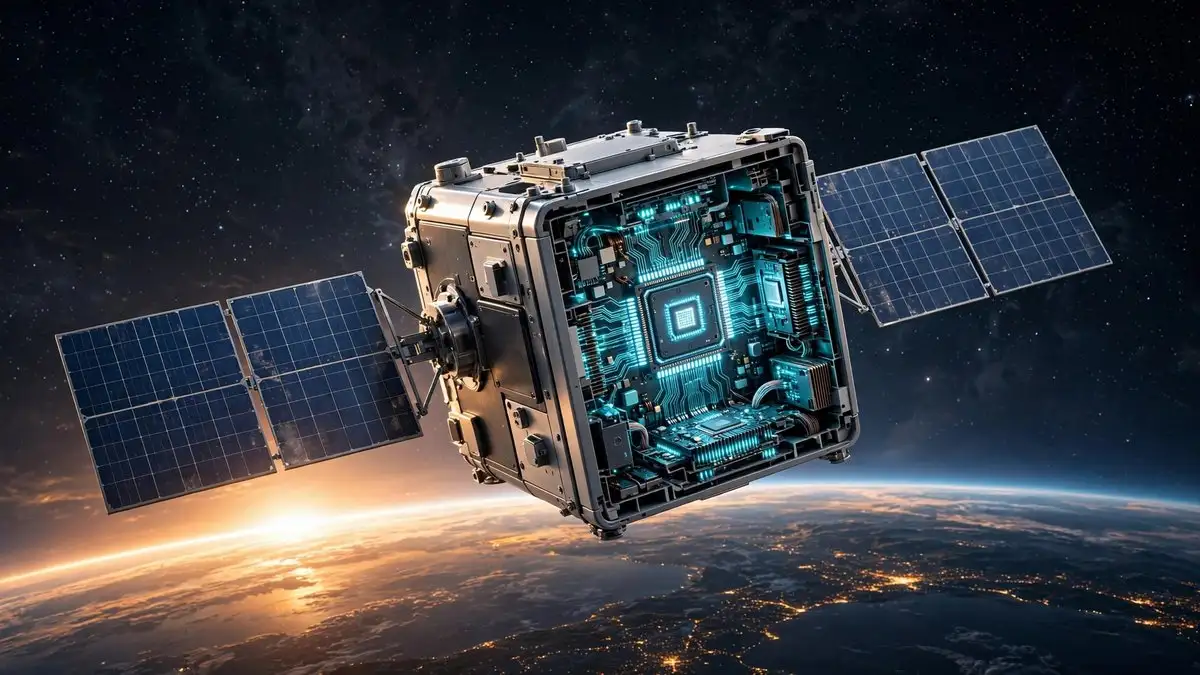
A refrigerator-sized satellite carrying four of Google’s AI chips is scheduled to leave Earth today, October 1, aboard a SpaceX Falcon 9. It is Google’s first attempt at running AI hardware in orbit, and the opening test of a project that could one day move data centers into space.
The satellite, which Google calls MVP, rides as one of 130 payloads on SpaceX’s Transporter-18 rideshare mission. The launch window opens at 11:18 a.m. Pacific Time (18:18 UTC) from Vandenberg Space Force Base in California. As with every rocket launch, the schedule can slip, and SpaceX has a backup window on October 2.
Google announced the mission in a September 24 update to its Project Suncatcher program, the company’s long-running research into whether solar-powered satellites could eventually host machine-learning infrastructure. Google’s framing of today’s flight is deliberately modest. “Can our TPUs survive and operate in space? Well, we’re going to find out,” Google CEO Sundar Pichai told Aviation Week.
What today’s flight is actually testing
Strip away the orbital-data-center headlines and today’s mission is a survival test, not a production system. Google wants to know whether its Tensor Processing Units, chips designed for air-conditioned data centers, can handle the physical abuse of launch and the hostility of low Earth orbit.
The numbers are blunt. The climb to orbit lasts about 10 minutes, during which the spacecraft endures sustained acceleration up to 10 times Earth’s gravity. Individual components, including the TPU chips, can see peaks of 50 to 100 g. Google says it shook the satellite along all three axes before clearing it for flight.
Radiation is the quieter threat. Energetic particles can flip memory bits or corrupt calculations, and vacuum removes the convective cooling that chips rely on. To prepare, Google tested its Trillium TPUs with a proton beam at UC Davis’s Crocker Nuclear Laboratory. The chips withstood a total ionizing dose greater than the shielded dose Google expects over a five-year mission, though that result is from ground testing, not orbit.
The satellite itself is small by design. Four Trillium TPUs, about one kilowatt of solar power, and a plan to run Gemini workloads in bursts of roughly 15 minutes before pausing to cool down. Google plans a one-year mission, and the spacecraft is designed to deorbit within about six years.
Why Google wants AI computers in space
The motive is energy. AI data centers on Earth are bottlenecked by electrical grids, land availability, and water-hungry cooling. Orbit has none of those constraints, and sunlight is free.
“If you put a solar panel in the right orbit, it generates five to eight times more power than that same panel down on Earth,” Travis Beals, Google’s Project Suncatcher lead, told Aviation Week. Maria Biggs, an engineering director at Google, framed the research question as whether the company can efficiently scale AI infrastructure by harnessing the Sun’s abundant energy.
Today’s flight is step one. Google plans to launch two more satellites in early 2027 to validate laser links between spacecraft. Beyond that, the research envisions clusters of more than 80 satellites connected by 1.6 terabit-per-second optical interconnects, flying in dawn-dusk orbits that keep their panels in near-constant sunlight, according to analyst coverage from Futurum.
The part nobody has solved yet: heat
Here is the catch. Generating power in space is easy. Getting rid of heat is the hard part. There is no air in orbit, so there is no convective cooling. Every watt a TPU burns has to be radiated away as heat, or the chip cooks itself.
Google says it is exploring combinations of heat pipes and radiators, tested in vacuum chambers. But the MVP satellite can only run its chips for about 15 minutes at a stretch before cooling forces a pause. That limit is exactly what today’s telemetry is meant to measure, and it is the mission’s most revealing number.
Put side by side, the gap between prototype and ambition is enormous:
| System | Chips | Power | Cooling | Status |
|---|---|---|---|---|
| Suncatcher MVP (Google) | 4 Trillium TPUs | ~1 kW solar | Heat pipes + radiators; ~15-min bursts | Launching today |
| Typical AI data center (Earth) | Thousands of accelerators | Megawatts | Liquid cooling | Operating |
| MOI-1A (TakeMe2Space) | Nvidia Thor GPUs | ~100-kg class satellite | Orbital test platform | Also flying on Transporter-18 today |
| SpaceX orbital data centers | Undisclosed | Unknown | Unknown | Ambitious plans, per reports |
Two details in that table matter. First, the Indian spacetech startup TakeMe2Space is flying its MOI-1A orbital-computing satellite on the same Transporter-18 mission today, with optical links designed to let satellites share computing workloads. Google is not alone in this race. Second, SpaceX, Google’s ride provider, has its own orbital data center ambitions, which makes today’s flight a slightly strange partnership.
What this means if the test works
Even a perfect flight proves very little about orbital data centers. What it proves is that the building blocks can survive the trip, which is the prerequisite for everything else. If the TPUs return clean telemetry after launch loads and radiation exposure, Google can justify the 2027 laser-link demonstration and, eventually, cluster designs.
The economics remain speculative. Futurum estimates orbital compute could address a $1 trillion market by 2030, but only if launch costs collapse, and its cost models do not see parity with off-grid terrestrial data centers until the mid-2030s. That is a bet on launch economics, not just chip physics.
For now, the interesting thing about today’s launch is its honesty. Google is not claiming it built a data center in space. It is claiming it built a thermometer that can fly, and that is exactly the right first question. If you are curious what those TPUs will be running once they survive, the same chips power models like Google’s new Gemini 4 Argon, and the price pressure on AI compute is part of why OpenAI just cut its flagship-class pricing at DevDay. Cheap intelligence needs cheap power, and Google is looking for the cheapest power of all.