
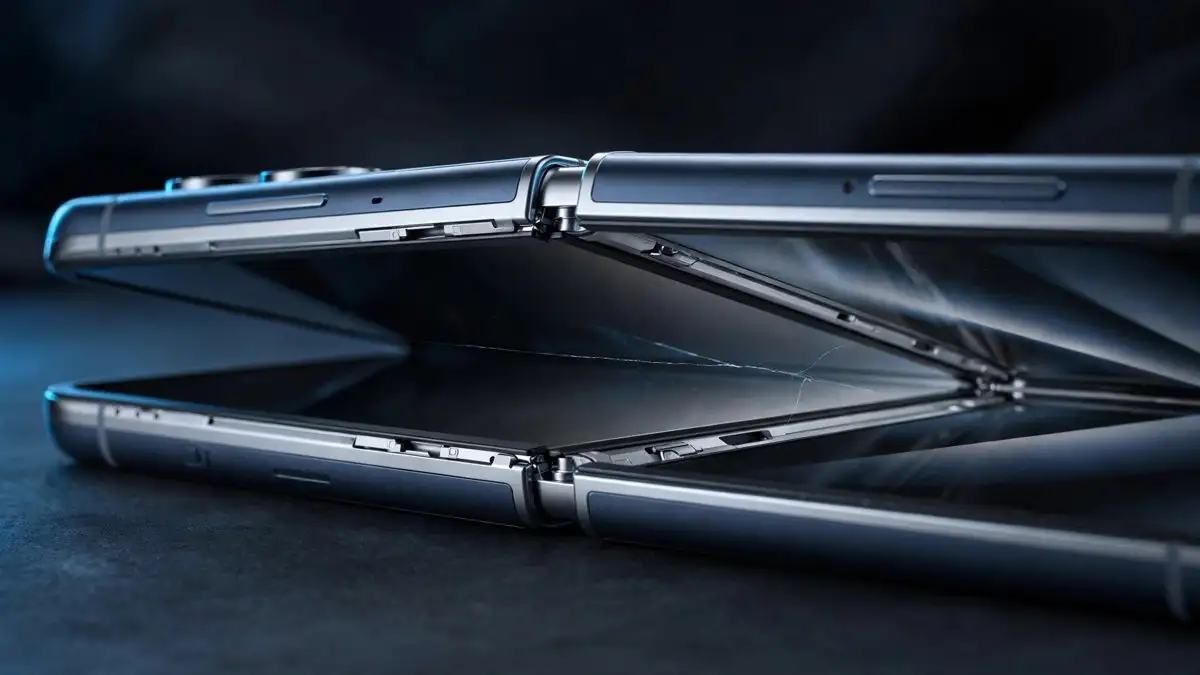
Three weeks after Apple’s first foldable went on sale, the mystery of its cracking inner screens may have a culprit. A leak out of China says the problem is not the hinge design at all. It is a batch of bad material from one of the two companies that make the hinge.
That is the claim, at least. Apple has confirmed none of it, and the evidence so far points in two directions at once. Here is what the leak actually says, what Apple has confirmed, and what Duo owners should do while the cause is still officially unknown.
What the leak actually says
On the evening of November 7, Chinese tech analyst Kang posted on Weibo that the hinge problem had “largely been traced” to the material supplied by one of Apple’s two hinge makers. The design itself, he said, works fine. Apple can identify the affected phones from their serial numbers, because the bad parts came from a single batch.
The post was picked up the same day by PhoneArena, amplified on X by leaker Ice Universe, and covered the next day by Japan’s iPhone Mania. By November 10 it had spread to TweakTown, Techaeris and Gadget Review, and on November 11 to The Mac Observer.
Three details in Kang’s original post keep getting lost in the retelling. He did not name the supplier. He did not identify the material. And he cautioned that his information should not be treated as a final conclusion. A widely shared X post from an account called Federighi’s Assistant went further, claiming “Apple and Foxconn have identified the source of the problems.” Foxconn does not appear in Kang’s report, and nothing in the chain names the assembler.
The supplier denial, and why it does not settle it
One hinge component maker has already gone on the record. South Korea’s Fine M-Tec, which makes the metal support plates that sit under the Duo’s flexible OLED panel, issued a statement on October 26 saying the reported quality problems were not caused by defects in components it supplied. The company added that singling out one part as the cause requires an objective technical review, and said it was reviewing civil and criminal legal action.
That denial does not close the question. Fine M-Tec makes support plates, not the hinge assembly itself, and Kang’s leak is about hinge material. Market reports link the hinge assembly to two other suppliers, Amphenol of the United States and Shin Zu Shing of Taiwan, with the liquid metal hinge shaft supplied by Yian Technology. No source has said which of them delivered the batch in question, so read those names as a supply chain fact, not an accusation.
The teardown evidence points the other way
The strongest counterpoint to the leak comes from the teardowns. iFixit’s analysis found the cracks are not concentrated at the usual stress point where the display cable passes through the hinge. They sit slightly lower, in the transition zone where the gap between the crossing cables leads into the central hinge support. That pattern points toward pressure from the hinge structure itself, a design and manufacturing question, rather than the quality of one part’s material.
A separate teardown added a new data point on November 10. YouTuber CuriousHagi took apart a cracked Duo and found a thin hinge ring snapped at the exact point where the crack starts, with impact marks under the display. If the ring gave way because of a defective material, that account would fit Kang’s leak. But no source links the two findings, and one phone does not explain the others.
It is worth remembering that the hinge itself has already passed one extreme test. A Duo survived 260,000 folds on a CNET livestream without the screen cracking, which suggests the design can take far more abuse than a normal owner will ever give it. A bad batch of parts would explain why only a small number of phones fail early while others fold hundreds of thousands of times.
What Apple has confirmed, and what it has not
| Confirmed | Still unconfirmed |
|---|---|
| A small number of Duo units have inner display failures (acknowledged October 26) | The root cause of the cracks |
| Free replacements under the standard manufacturing warranty, no AppleCare+ needed | Which supplier, if any, delivered defective material |
| The Duo went on sale October 23, starting at $1,999 | Serial number ranges for the affected batch |
| Apple says it is aware of the issue and is offering replacements | A public serial number lookup tool, or a proactive replacement program |
The distinction matters for buyers still waiting on their orders. A material defect confined to one batch would mean most Duos are fine, and Apple could quietly swap the affected units. A design flaw would be a far bigger problem, and would likely mean a recall. The leak, if true, is the good outcome. It is also, for now, only a leak.
What Duo owners should do now
If your Duo makes a crunching or popping sound near the hinge, or you see a raised bump under the inner display, stop folding it and contact Apple Support right away. Affected owners are getting free replacements under the standard warranty, and you do not need a paid protection plan to get a broken unit swapped.
Do not wait for a serial number lookup tool that may never arrive. Apple has published no affected ranges and no public check, and it has not said whether it will proactively replace phones that have not failed yet. The practical test is still the phone in your hand, not a list.
The wait for a new Duo is still long. Our guide to the 89-day wait explains how to get one sooner, and the 256GB model has started showing up in stores. Meanwhile, Apple says the Duo now has 100,000 optimized apps, though the biggest names are still missing. The hardware story is moving faster than the software one, and the next chapter depends on whether Apple confirms what Kang claims.
Sources: Mac Observer, TweakTown, Techaeris, Gadget Review, PhoneArena, iPhone Mania, iFixit.