
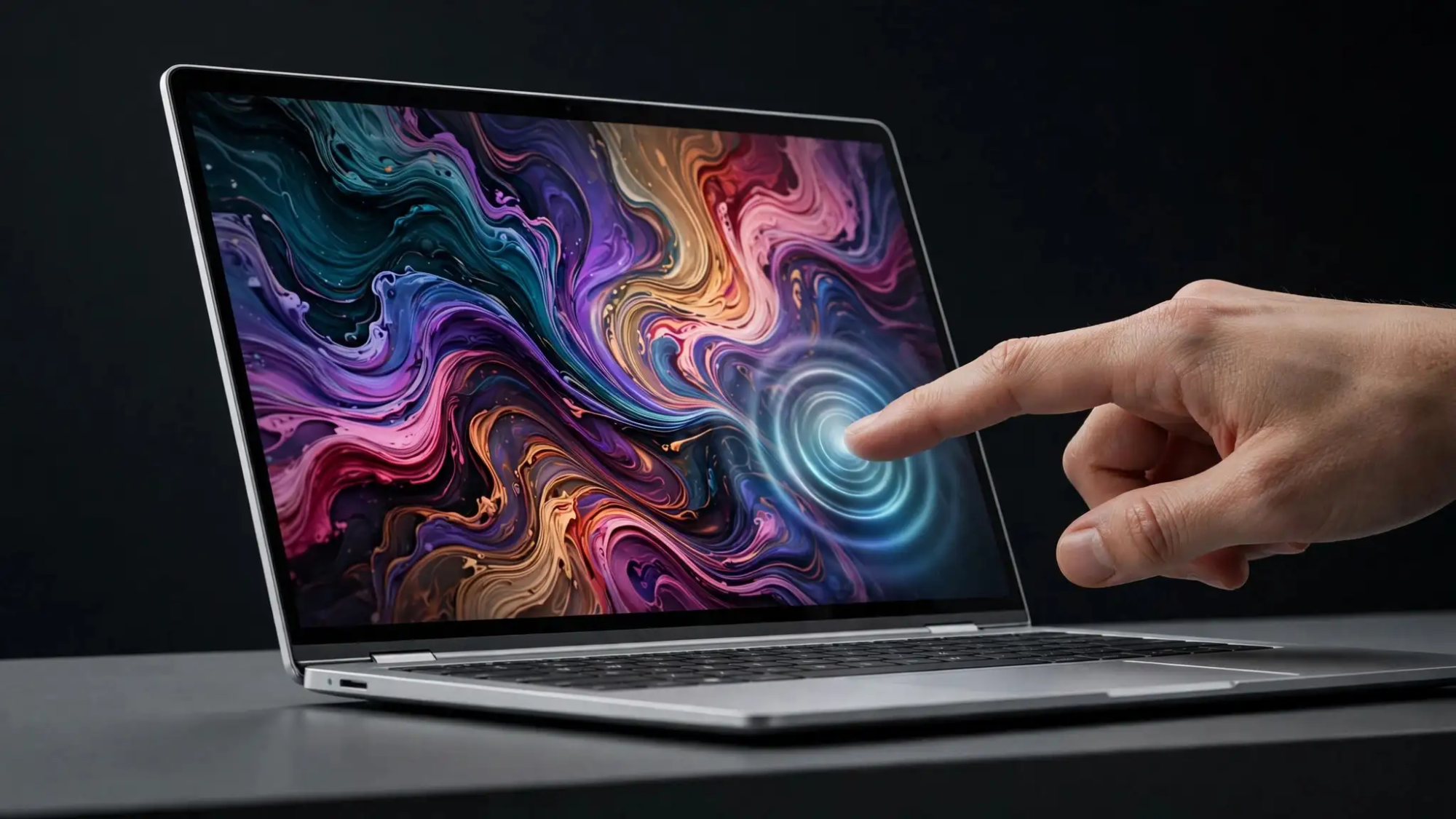
Apple’s busiest October in years just got a second act. Days after officially announcing its October 13 “Welcome Home” smart home launch, Bloomberg is now reporting that Apple will follow it with a second product launch on or around October 27, headlined by something the company swore for decades it would never build: a touchscreen MacBook Pro with an OLED display.
If the report holds, October 2026 will have delivered two full Apple launch events in two weeks, and the second one contains the biggest Mac redesign in years. Here is what is reportedly coming, and why a touchscreen Mac finally makes sense now.
The first touchscreen Mac, after decades of “no”
Apple executives spent the better part of a decade explaining why touchscreens did not belong on the Mac. Steve Jobs called it “ergonomically terrible” back in 2010, and the company has repeated versions of that line ever since. Now, according to Bloomberg’s reporting via MacRumors, the 14-inch and 16-inch MacBook Pro are going touchscreen anyway.
The reported changes are substantial: thinner and lighter chassis than the current MacBook Pro, OLED displays, touchscreen capability, and a Dynamic Island borrowed from the iPhone. This is not a minor refresh. The MacBook Pro has not had a meaningful redesign since the 2021 overhaul, and OLED plus touch would be the biggest change to the line in five years.
There had been rumors the touchscreen OLED machine might launch under a new “MacBook Ultra” name. Bloomberg’s reporting points the other way: the 14-inch and 16-inch models stay in the MacBook Pro family.
What else is on the October 27 slate
The MacBook Pros are the headliners, but they are not alone. Bloomberg says the same launch will include a 14-inch MacBook Pro with the M6 chip, a 24-inch iMac with the M6 chip and new color options, and an iPad mini with its first OLED display, a landscape-oriented camera for video calls, and a redesigned speaker system.
The iPad mini detail is worth pausing on. A smaller tablet getting OLED before the MacBook Air suggests Apple is treating the mini as the display-technology showcase in the tablet line, similar to how the iPad Pro got OLED first. The landscape camera also signals that Apple sees the mini as a video-call and FaceTime device, not just a reading tablet.
Timing-wise, this lands right after the Mac Studio refresh. Apple released new Mac Studio models with M5 Max and M5 Ultra chips last week, with a high-end 512GB RAM configuration arriving in late October. The desktop and laptop lines are being rebuilt in parallel.
Why a touchscreen Mac makes sense in 2026
The strategic context matters here. Apple is putting touchscreens on the Mac the same year it shipped Microsoft’s Surface Laptop Ultra with Nvidia’s RTX Spark showed up as a genuine gaming-capable Windows rival, and the same year iPadOS and macOS have been converging in how they handle apps, windows, and now AI agents. The wall between “touch device” and “keyboard device” has been eroding for years; Apple just stopped defending it.
There is also an AI angle. The October 13 launch is built around Siri AI and the smart home, with the new home hub, Apple TV 4K, and HomePod mini 2, all of which we covered when the details leaked. A touchscreen Mac fits the same pattern: Apple is making its interfaces more conversational and more direct, and touch is the most direct interface there is.
And practically, the Mac needed a display story. Windows laptops have had OLED options for years, and Apple’s mini-LED Liquid Retina XDR, good as it is, was starting to look like last decade’s technology in spec-sheet comparisons. OLED closes that gap in one move.
What we still do not know
Pricing is the big unknown. The current 14-inch MacBook Pro starts at $1,999 and the 16-inch at $2,499, and OLED panels plus touchscreen digitizers are not free. Apple could hold the line and absorb the cost, or the redesign could be the excuse for a price bump. Either way, expect the announcement to frame the value in display quality and thinness rather than raw specs.
The other unknown is how macOS handles touch. A touchscreen without touch-optimized software is just a smudgy screen, and macOS has never had touch targets. Apple has reportedly been adapting interface elements, and the Dynamic Island’s arrival on the Mac hints at interface ideas carried over from iOS. But the real answer comes when developers get the machines and the new SDKs.
Two launches, one strategy
Step back and the picture is clear. As our October 2026 Apple calendar laid out, this month was always going to be packed: iPhone Duo pre-orders, the October 13 smart home event, and now the October 27 Mac launch. Apple is running two product stories at once, the home and the computer, both built around the same bet: that AI makes devices you touch and talk to more valuable than devices you just type on.
The October 13 event is an “Apple Experience” media session in Tribeca, New York, at 9 a.m. ET, with an online video presentation. Expect the same format for the 27th. And if you are in the market for a Mac, the advice writes itself: do not buy one before October 27. The current MacBook Pro is about to become the last non-touchscreen Mac Apple ever sold, and that alone makes it worth waiting two weeks.