
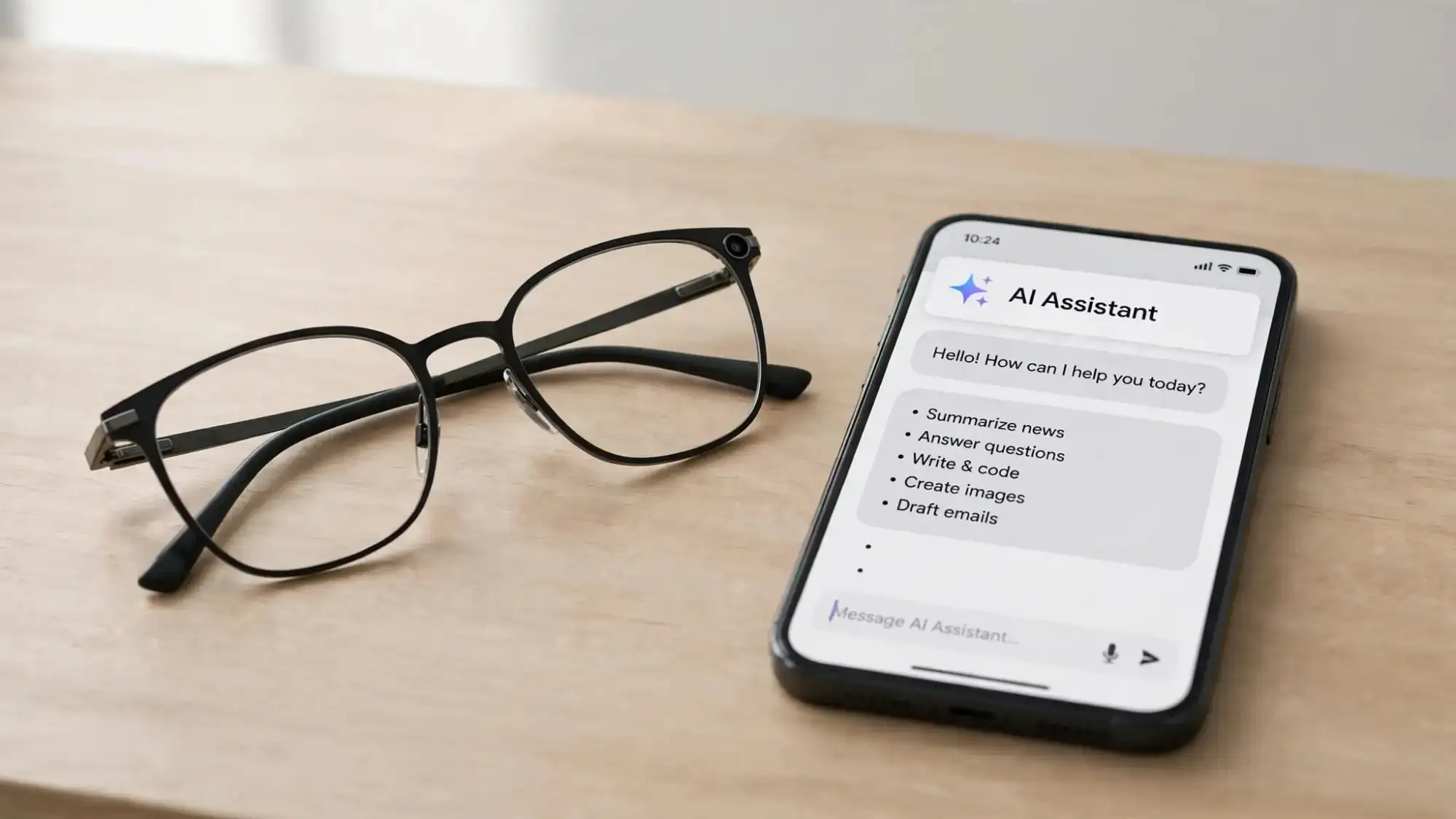
Samsung’s first smart glasses are real, they have a price, and they ship in less than a month. Pre-orders for the company’s Intelligent Eyewear opened on November 12 in the United States and South Korea, with deliveries starting December 10. Warby Parker models start at $395, roughly Rs. 35,000, and Gentle Monster versions run from $449 to $489. Google’s Gemini does the thinking. Samsung supplies the hardware. And in a move that says a lot about who Google is selling to, the glasses work with iPhones too.
The lineup covers 30 designs across the two eyewear brands. Gentle Monster offers six frame styles in 16 variations, in colors including dark red, pink, gray, and yellow. Warby Parker has three designs, Alden, Reid, and Wren, in 14 variations, with optical or sun versions and prescription, width, and lens options. You buy through Warby Parker’s or Gentle Monster’s own channels, not from Google, which is not selling the glasses directly at launch.
No screen, just a camera and Gemini
These are display-free glasses. There is no heads-up display and no screen projected onto the lens. The interface is a 12-megapixel camera, an open-ear speaker array, and a microphone array, with Gemini answering by voice. Ask about a landmark you are looking at, translate a menu, get walking directions through Google Maps, or have meeting notes summarized into Samsung Notes. The glasses run Android XR and carry both Gemini and Bixby, on Qualcomm’s Snapdragon AR1 Gen 1 chip, a processor built specifically for display-free smart glasses.
Battery life is rated at about nine hours, according to 9to5Google. That covers a working day of occasional queries, though heavy camera use will cut into it. The glasses are thin and light, which is the point: Samsung and Google are betting that people will wear AI glasses all day only if they look and feel like ordinary glasses.
The iPhone compatibility is the real story
The glasses work with Galaxy phones running One UI 9.0 or higher, Google Pixel 7 and above, and the iPhone 13 Pro and above. That last entry matters more than the rest. Google is selling a Gemini product to Apple’s customers before it has reached every Android phone, and it is doing it through fashion brands that iPhone owners already shop at.
There is a catch, and Samsung has not hidden it, exactly, but it has not spelled it out either. The heavy processing runs on the connected phone, not in the frames. Samsung has confirmed pairing works with iPhones and non-Galaxy Android phones, but it has not published a full feature comparison, and the full Gemini experience is designed around a Galaxy AI phone with an active data connection. If you pair with an iPhone, expect the basics to work and the deeper integrations, like summarizing notes straight into Samsung Notes, to be limited or absent. Check the fine print for your phone before pre-ordering.
Privacy first, because Meta set the bar low
Google is also addressing the privacy question up front, which is a deliberate contrast with Meta’s Ray-Ban glasses, the current category leader. The glasses redact nearby faces before Gemini processes images, according to TechBriefly. It is a small technical detail with a large message: these glasses are not meant to record the people around you.
The glasses only work with Google accounts from the United States or South Korea at launch, which limits the audience further. Demos start December 10 at seven Samsung Experience Stores in the US, including Mall of America and Roosevelt Field, plus 65 Warby Parker locations and pop-ups in New York.
What to do if you are tempted
At $395, the Warby Parker models undercut Meta’s display-equipped Ray-Ban glasses and land in impulse-buy territory for a gadget, if not for eyewear. The Gentle Monster versions, at up to $489, are a fashion purchase first and a gadget second. Try them on before you buy if you can, and confirm which features work with your phone, especially if that phone is an iPhone.
Samsung is not trying to win the smart glasses category on specs. It is trying to win it on distribution, through two eyewear brands with real stores, and on Gemini, which is now Google’s answer to almost everything. The glasses are the most wearable version of that bet yet. Whether people want an AI assistant on their face all day is the question December 10 will start answering. For context on where Gemini is heading, see our coverage of Gemini 4 Hydrogen, Google’s cheapest Gemini 4 model, and Gemini 4 Carbon going generally available, plus the November Pixel Drop that brought Gemini intelligence to the Pixel 10.
Sources: Samsung via SamMobile and Android Headlines, November 12, 2026; Google via Make Tech Easier, November 13, 2026; TechTimes, November 12, 2026.