
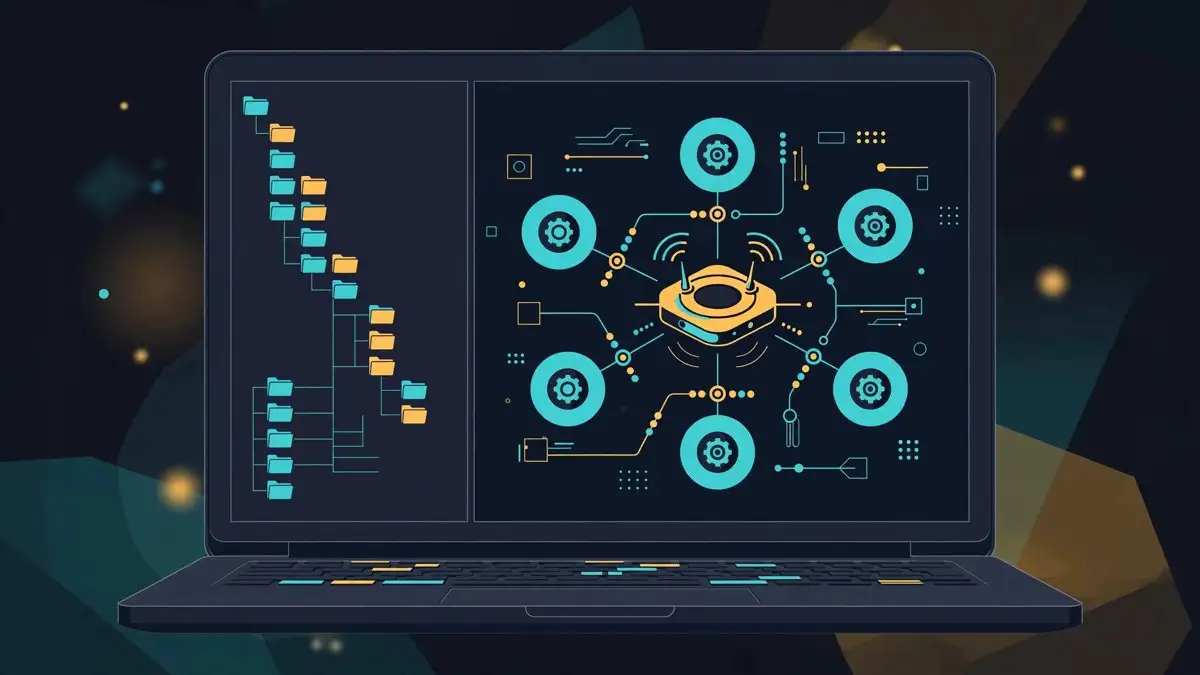
DeepSeek has quietly published one of the most interesting pieces of AI infrastructure of the year, and it is not a model. On October 31, the company’s Harness team open-sourced dsh-superagent, a research prototype of an always-on coding agent that watches a single GitHub repository, takes requests from people you allow, and turns them into pull requests while you sleep.
The code is MIT licensed, which means anyone can download it, inspect it, modify it, and run it on their own machine. Within about a day of publication, the repository had passed 4,000 stars on GitHub, according to multiple trackers. Developers clearly want open coding-agent infrastructure they can run themselves, rather than renting it from a closed service.
The router and worker split is the whole idea
Most coding agents work in sessions. You open a chat, describe a task, and the agent works until it finishes or you stop it. DeepSeek’s design article, published alongside the code, argues that the unit of agent work should stop being the session.
In dsh-superagent, a component called the Router watches for incoming requests on GitHub and, optionally, on Feishu chat. When someone on the allowed list asks for work, the Router opens a Ticket, which is the project’s name for one unit of work, and hands it to a Worker. Each Worker runs in its own agent session and its own directory, isolated from the others, and reports back to the original conversation, for example by opening a pull request.
The point of the split is parallelism with identity. One agent keeps a continuous presence in the repository, while many workers do the actual coding at the same time. The Router can also run a Watchdog, which monitors long-running work and steps in when a task stalls.
What it takes to run it yourself
This is not an app you install and forget. The prototype is a bundle, effectively a plugin, for DeepSeek Harness (DSH), the open-source agent harness DeepSeek released on August 13. You install Harness with Node.js, and it serves a local web interface on your machine.
To run the super-agent you need a macOS or Linux machine with tmux, Node.js 22.19 or newer, pnpm, git, Python, and the GitHub CLI, plus a model provider such as a DeepSeek API key and a dedicated GitHub account for the agent with write access to the repository. The setup guide suggests asking a coding agent to walk through the steps, which is a fitting touch.
One early quirk is worth knowing before you try it. The first start exits with code 3 and a message saying the repository is unset. That is not a failure, it means the agent is waiting for setup to be completed. Independent testers who documented a November 1 install confirmed the same behavior.
DeepSeek is blunt about what this is not
The README carries warnings that matter more than the feature list. It calls the code a research prototype for reference only, not an official DeepSeek product, and says it is not identical to DeepSeek’s internal version. Some designs described in the accompanying article are future directions that are not implemented in the published code.
It also warns that the software has not undergone a security audit, and that its sandboxing and approval controls do not guarantee isolation. Workers run commands as the operator’s system user. That means anyone who deploys this on a repository should review every change the agent makes, configure the sandbox carefully, and treat the agent’s GitHub account as a privileged credential, not a toy.
This is the honest trade of open-source agent infrastructure. You get full control and no vendor lock-in, but responsibility shifts to you. There is no support desk, no managed review queue, and no one to blame if an unsupervised worker merges something it should not have.
Why this release matters beyond DeepSeek
The timing is notable. The same week DeepSeek published this prototype, the company also shipped a new coding model checkpoint, and open-weight models from Mistral and others continued to close the gap with closed labs. The pattern is consistent: the model is becoming a commodity, and the harness around it is becoming the product.
That is why dsh-superagent deserves attention even from developers who will never run it. It sketches a plausible shape for how software teams will work in the next few years: a persistent agent identity per repository, human approval at the boundaries, and parallel workers doing the bulk of routine implementation. The closed coding tools from OpenAI, Anthropic, and Google are all moving in the same direction, but their versions run on their servers, under their rules.
DeepSeek’s version runs on yours. For teams that cannot send code to a third-party cloud, or simply do not want to, that difference is the whole argument.
Should you try it this week
If you maintain an open-source repository and you are comfortable with experimental tooling, yes, on a throwaway repository first. Set up a dedicated GitHub account, give it access to one low-stakes repo, and watch how the Router handles a few small requests before you let it near anything real.
If you are looking for a production coding assistant for your company, no, not yet. Wait for the audit, the hardening, and the community forks that will inevitably clean up the rough edges. The prototype is a window into where agent tooling is headed, not a finished product.
Either way, the direction is clear. Agents are moving from chat windows into repositories, and they are staying there. DeepSeek just gave everyone the code to see how that works.
Sources: DeepSeek Harness team via the dsh-superagent-prototype repository on GitHub; MarkTechPost coverage; Developers Digest; Coheser. Star counts are reported figures from November 1, not live counts.
Related reading: DeepSeek V4.1-Flash-1017 beats Claude Sonnet 5.6 on 10 of 11 coding tests, DHS ordered US agencies to purge DeepSeek AI three months ago, Mistral Large 4 is now free to download.