
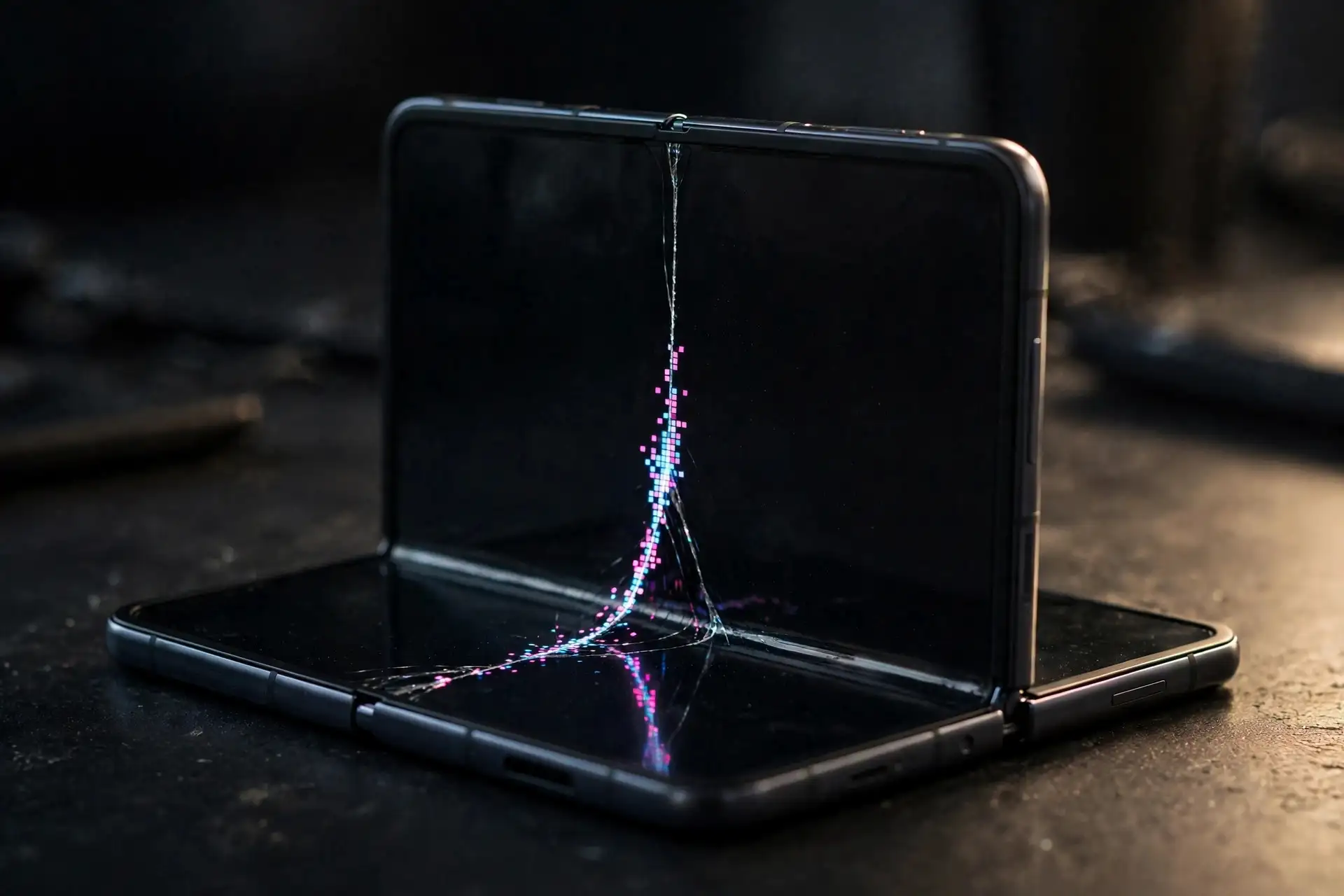
One week after the iPhone Duo went on sale, Apple has done the two things it usually does in a hardware scare, in the usual order. It has started replacing broken phones, and it has said almost nothing about why they broke.
The first foldable iPhone launched on Friday, October 23, starting at $1,999. Within hours, owners were posting photos of the inner display cracked along the centre crease, often with a bright line of stuck pixels running from the fold toward the right edge of the screen. On Monday, October 26, Apple confirmed the problem in a statement shared with Reuters, MacRumors, 9to5Mac and other outlets: “We are aware of an issue impacting the inner display on a small number of iPhone Duo units. If users experience issues with their iPhone Duo display, they should contact AppleCare for a replacement.”
That is the confirmed position. Almost everything else about this story, including the cause, the scale, and whether anything has changed on the production line, is still unconfirmed. Here is where things actually stand one week in.
What Apple has confirmed, and what it has not
| Confirmed | Not confirmed |
|---|---|
| An inner display issue affects a small number of iPhone Duo units | How many units are affected, or any failure rate |
| Affected owners should contact AppleCare for a replacement | The technical cause of the cracks |
| The fault tends to appear soon after purchase, and most units are not susceptible (via MacRumors) | Whether a revised hinge or display part is already in production |
| No AppleCare+ plan is required for a replacement tied to this issue (via 9to5Mac) | Any formal repair program, recall, or extended warranty with published terms |
There is no service program page for the cracks, no published terms, and no end date for the replacement offer. If your Duo is affected, the route is a person rather than a webpage: AppleCare, the Apple Support app, or an Apple Store.
Few cases, a consistent pattern, and no reliable count
Bloomberg verified accounts from more than six owners whose inner displays failed. The details repeat from case to case: a hinge that tightens, a popping or crunching sound while opening, then a crack along the fold. One Australian owner reported a fracture after about six hours of use and fewer than 20 openings, with no marks on the screen surface, and received a replacement in store. AppleInsider tried to size the problem informally by asking staff at 20 Genius Bars it trusts; as of October 26, those stores had seen four affected units come back. That is a useful reality check, not a failure rate, and Apple has published nothing more precise than “a small number”.
Counting is made harder by the photos. MacRumors and CNBC have both noted that some of the crack images circulating on social media are fake, including AI-generated ones. A viral picture is not evidence either way, and our earlier coverage of the first wave of owner reports found the same mix of genuine cases and unverifiable images.
iFixit’s support bar theory, and why it is only a theory
The most detailed explanation so far comes from iFixit, which tore the Duo down and built a three-dimensional simulation of its hinge. The reported damage clusters just below the point where the display cable passes a central support bar inside the hinge. iFixit’s working theory is that the bar may not retract far enough as the phone closes, leaving a pressure point close to where the screens are breaking. Its dust testing also found that grit could work its way into the hinge despite the phone’s IP68 rating.
Apple has not endorsed any of this, and iFixit itself describes the theory as preliminary. The hinge contains more than 100 parts from multiple suppliers, which is one reason the argument over blame that started this week is going nowhere fast.
The hinge supplier is denying blame, and threatening to sue
Fine M-Tec, the South Korean maker of internal hinge plates widely reported to be part of the Duo supply chain, posted a statement on its website on October 26, reported in English by The Elec. It said the quality issues recently reported in certain products “were not caused by defects in components supplied by our company”, and that it is considering legal action, including civil and criminal proceedings, against claims that blame its parts without objective verification. The statement does not name Apple or the iPhone Duo at all.
A second claim surfaced on October 29: an X post relaying a purported Foxconn employee who alleges Apple relaxed some quality inspections to hit launch volume. The identity behind it is unverified, Apple has not responded, and nothing yet links any inspection change to the cracks. Until someone puts a name to it, treat that one as a rumour.
Replacements are real, but stock is the bottleneck
The replacement promise is being honoured, unevenly. Some owners have walked out of an Apple Store with a new phone the same day. Others, particularly buyers who purchased through carriers, have been told there is no stock, and 9to5Mac reports that some were initially told the damage looked like a drop and were quoted a repair bill instead. That distinction matters, because the bill is steep: an out-of-warranty inner display repair is listed at $999, exactly half the price of the phone, or $99 with AppleCare+. With new Duo pre-orders already slipped to late January, replacement units are competing with the same constrained supply.
If your Duo is showing symptoms, our owner’s guide to the warning signs and the replacement process walks through the checks and the exact steps to take, including what to say if you are told the crack was your fault. And if you are still deciding whether the Duo is worth the risk, demand has not collapsed: analysts expect it to take close to 30% of the foldable market in 2027.
What to watch next
Three things will show whether this stays a launch-week story or becomes something bigger: a formal Apple service program with published terms, any failure-rate figure from Apple or a regulator, and evidence that phones now leaving the factory carry a revised hinge or support bar. None of the three exists yet. Until one does, the honest summary is short. A small number of $1,999 phones are breaking at the fold, Apple will replace them if you ask, and nobody, including the company reported to make the hinge plates, is willing to say why.