
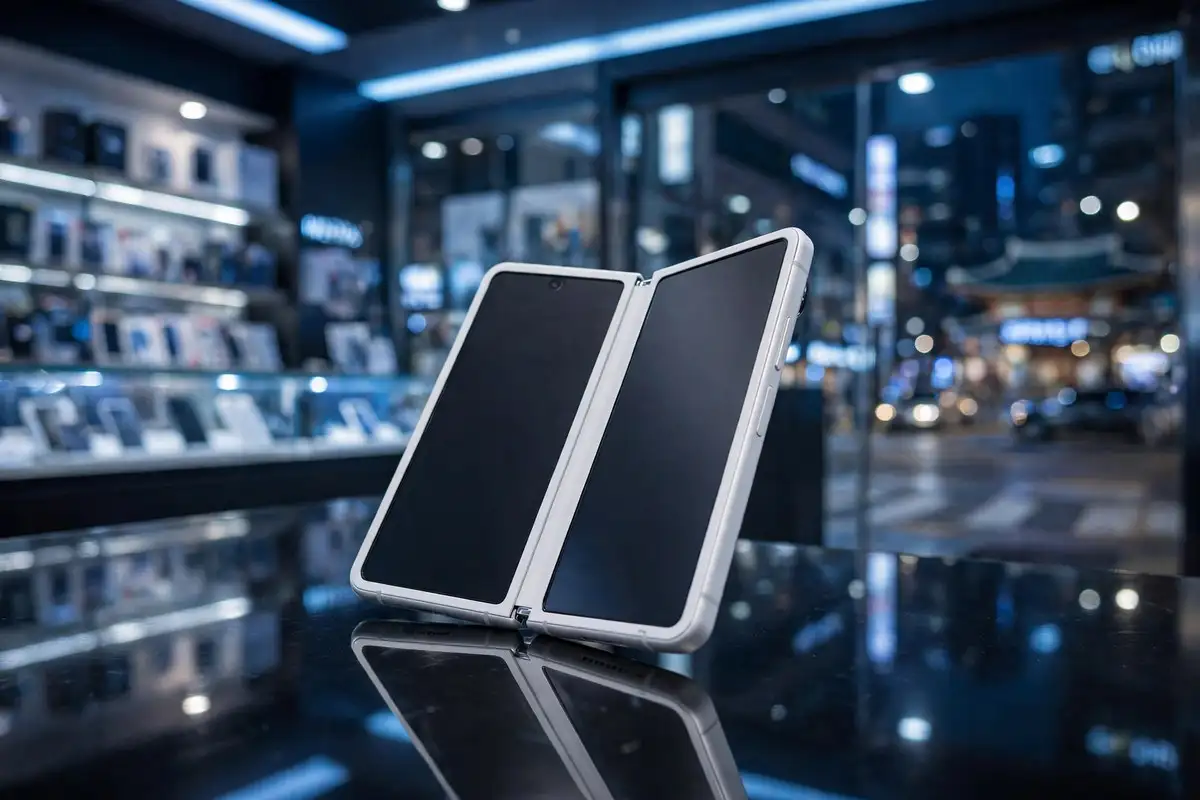
Apple’s first foldable iPhone goes on sale today, and South Korea just gave the world its clearest look yet at who is buying it. All three major carriers, SK Telecom, KT, and LG Uplus, reported that their first-round iPhone Duo pre-order stock sold out in about one minute, with buyers overwhelmingly choosing the Star White color and the two highest storage tiers.
The launch-day numbers matter because Korea is one of the world’s most competitive smartphone markets, and the carriers published unusually detailed breakdowns of what buyers picked. The data tells a story about a customer Apple rarely sees: price-insensitive, early, and very sure about what they want.
One minute, three carriers, one pattern
SK Telecom said its first-round pre-order allocation, which guaranteed delivery on launch day, ended within a minute. The 256GB and 512GB models together accounted for 60 percent of its reservations. In other words, the cheapest configuration most buyers even considered started above the $1,999 base price.
KT reported the same one-minute sellout for the first two rounds of 256GB and 512GB stock on its KT Direct Shop. Seven out of every ten KT buyers chose Star White over Night Sky. LG Uplus was more granular: Star White took 69.4 percent of reservations, the 256GB model 51.8 percent, and the 512GB model 40.7 percent. Add those two storage tiers and more than nine out of ten LG Uplus reservations were for the higher-capacity phones.
The age split is just as telling. At SK Telecom, buyers in their 30s were the largest group at 36 percent, followed by those in their 40s at 35 percent, and those in their 20s at just 13.9 percent. The iPhone Duo’s launch-week buyer is not a young early adopter with disposable income; it is a 35-to-45-year-old with money to spend.
Why the storage numbers are the real headline
Foldables have historically skewed toward the base model, since the headline price already stretches most budgets. That pattern is absent here. When 60 to 90 percent of buyers at the big three carriers pick the 256GB or 512GB configurations, the $1,999 starting price is not acting as a ceiling. The entry 256GB model is listed at 3.29 million won in Korea, roughly $2,300 at current exchange rates, a meaningful premium over the U.S. price.
That has implications beyond Apple’s launch weekend. DigiTimes, citing supply chain sources, reported this week that Apple raised its 12-month iPhone Duo shipment target by 44 percent, from 9.7 million units to 14 million, after pre-orders slipped to January 2027 delivery estimates within 30 minutes of opening in the U.S. DigiTimes also forecasts global foldable shipments growing 25.7 percent in 2026 and 59.1 percent in 2027, with Apple’s entry doing the heavy lifting.
What today looks like if you did not pre-order
Walk-in buying remains the hard way to get a Duo. Apple warned this week that stores will have limited launch-day stock, and in markets including South Korea, China, Japan, India, France, and the UAE there is no walk-in purchase at all, only online pickup reservations. South Korean buyers are therefore almost entirely funneled through carrier and Apple online channels, which makes the one-minute carrier sellouts the best available proxy for launch demand in the country.
The carriers are competing hard for the overflow. SK Telecom is bundling two months of Google AI Plus with 400GB of storage and six months of Tving’s ad-supported streaming plan for customers who activate by November 30. KT is promising first-wave buyers delivery on launch day and second-wave buyers delivery within three days. LG Uplus is pushing its 70 percent compensation pass, a 18,000-won-per-month program that lets customers trade the Duo back from the sixth month for points worth up to 70 percent of the device price.
The read-through for the rest of the launch
Two caveats before anyone extrapolates. First, carrier allocation sizes are unknown, so “sold out in one minute” describes speed, not volume. Second, early reviews note that the hardware impresses while the app ecosystem is not yet fully ready for the foldable form factor, which could slow the second wave of buyers.
Still, Korea’s launch-day data answers the question analysts have asked since September: is there really $2,000 demand for a foldable iPhone, or just $2,000 curiosity? The color, storage, and age breakdowns point to demand. Buyers in their late 30s and 40s picking Star White in 256GB or 512GB within seconds are not curious. They know exactly what they want, and Apple now has to make enough of it.