
Apple almost did not make it. In August, just weeks before the iPhone Duo went public, the company believed production constraints could keep its first foldable phone from going on sale until later in November, according to a report from Bloomberg’s Mark Gurman published over the weekend via MacRumors and The Apple Post. Apple has since built enough inventory to hold the October 23 launch date, but Gurman says stock will stay limited, and the retail plan tells the story of a launch running on tight supply.
August: Apple braced for a November slip
The iPhone Duo was unveiled on September 9, 2026, with a starting price of $1,999 in the US and £1,999 in the UK. India pricing has not been announced yet. Behind the scenes, August was apparently a tense month in Cupertino. Gurman reports that Apple seriously considered that the Duo might not go on sale until later in November, and only a steady build of inventory in recent weeks locked in the October timeline.
The pressure is visible in the numbers. Analyst Jeff Pu cut his 2026 iPhone Duo shipment estimate to 6 million units in mid-September, down from 7 million, citing hinge constraints. A Chinese business outlet reported that Foxconn’s final-assembly yields for the Duo were sitting slightly above 60% as of September 17. Foldables are hard to build at scale, and Apple appears to be feeling that more than anyone.
The schedule is still intact. Apple’s October calendar holds: pre-order preparation (“Get Ready”) opened today, October 12; pre-orders begin October 16 at 5 a.m. PT (1 p.m. UK); the Duo goes on sale October 23 in more than 70 countries and regions, shipping with iOS 27.1; and 28 more countries follow on October 30.
Demo units everywhere, buyable stock thin
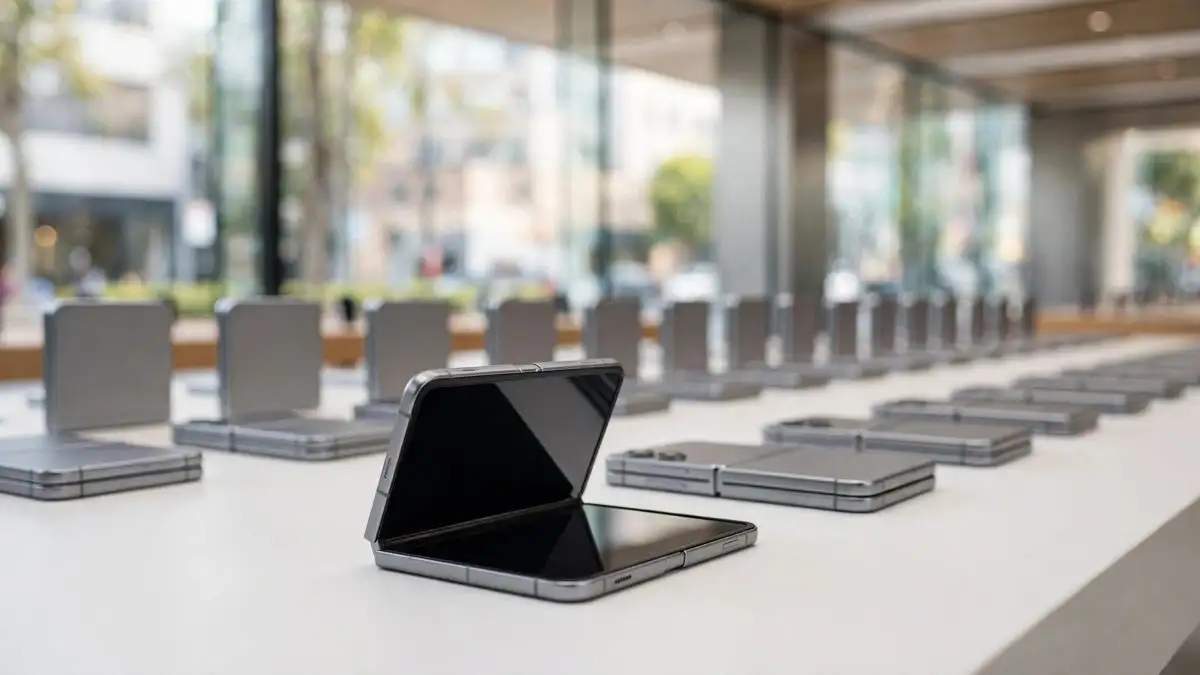
Here is the part of the story that reveals Apple’s real strategy. While sellable inventory stays limited, Apple is flooding its stores with demo units. The logic is easy to read: if checkout day is going to be brutal, let everyone touch the phone first so the demand survives the wait.
The scale of the retail showcase is striking. Apple’s Fifth Avenue flagship in New York will get a dedicated iPhone Duo section stocked with more than 150 demo units. The Apple Park Visitor Center gets nearly 100. Chicago’s Michigan Avenue store, The Grove in Los Angeles, and the Upper West Side in Manhattan each get 30 to 40. Regular stores get around 20 each.
How many demo units each store tier gets
| Store | Demo units |
|---|---|
| Fifth Avenue flagship, New York | 150+ |
| Apple Park Visitor Center | Nearly 100 |
| Chicago Michigan Avenue, The Grove LA, Upper West Side Manhattan | 30-40 each |
| Other Apple stores | ~20 each |
Inside the Duo launch-day store setup
Gurman details a retail choreography that is unusually elaborate, even by Apple standards. Stores will get a new demo fixture that folds and unfolds the Duo to show off the hinge, plus an extra spotlight table dedicated to the phone. A MagSafe stand will hold an unfolded Duo next to two standard iPhones, presumably to make the size comparison obvious.
Untethered units will run StandBy mode in the stores’ Avenue areas, and Apple has built Duo-specific Presto machines, the in-store wireless systems that update the software in a sealed box and display a personalized “Hello” greeting when the phone is first opened. Every one of these touches says the same thing: this is a device Apple wants you to experience in person, because a photo on a webpage does not sell a folding phone.
That experience-first play also makes sense next to the competition. Samsung’s foldables have been on shelves for years, and the iPhone Duo vs Galaxy Z Fold 8 comparison shows how closely the two are being watched. Apple knows curious shoppers will cross-shop. Getting the Duo into hands before it is easy to buy is a way to win that comparison in person rather than on spec sheets.
What this means for buyers
A launch where demo units are plentiful but boxes are scarce creates a specific kind of buying problem. Store pickup slots and launch-day delivery windows will likely sell out in minutes on October 16, and the wait between ordering and receiving could stretch into November anyway. Apple’s own retail plan is practically an admission of this: the 150-unit Fifth Avenue showcase exists to keep interest alive while the supply chain catches up.
There is a silver lining for patient buyers. Products launched on constrained supply sometimes work out their early manufacturing kinks during the wait. A slightly-above-60% final-assembly yield at Foxconn does not inspire confidence about first-batch units, so waiting for a later production run is not just a consolation, it might be the smarter purchase.
What to do this week
If you want a Duo on day one, treat October 16 like a concert ticket drop. Apple’s “Get Ready” pre-order preparation is open now, so set up your carrier details, trade-in, and payment method in advance. Be ready at 5 a.m. PT (1 p.m. in the UK). Decide now whether you want store pickup or delivery, and have a second choice ready, because the first will probably vanish fast.
If you are not in a rush, walk into a store on or after October 23 and spend real time with the demo units, especially the folding fixture and the MagSafe comparison stand. A $1,999 purchase deserves hands-on time. You can also watch how quickly shipping estimates slip on launch day; if they push deep into November, waiting costs you nothing.
And if the price or the wait puts you off entirely, alternatives are already cheap. Samsung’s foldable hit a record low during Prime Day, which makes it a realistic stand-in while Apple works through its hinge constraints. The Duo will still be there when supply normalizes, and it will probably be a better phone by then.