
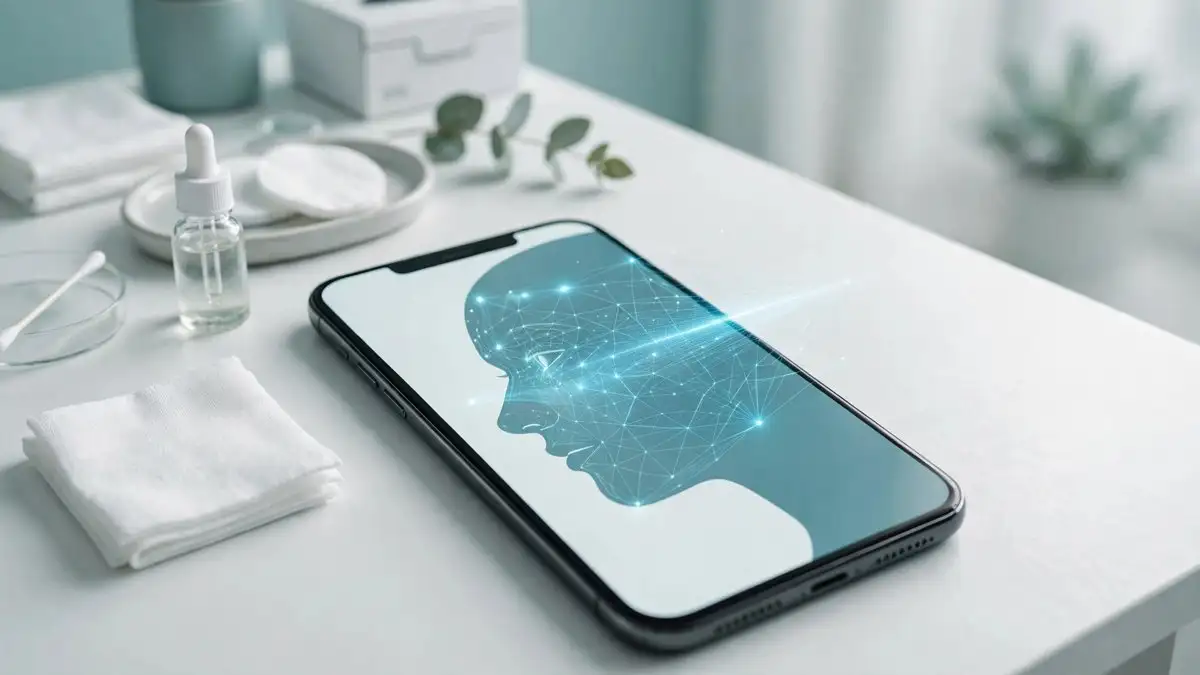
Utah just did something no U.S. state has done before: it let an artificial intelligence write first-time prescriptions. On October 5, the state’s Office of Artificial Intelligence Policy announced an agreement with Nolla Health, a dermatology startup, allowing the company’s AI to assess adult patients and issue initial prescriptions for acne. Bloomberg broke the story, with Digital Trends, Medical Economics, unite.ai, and superpowerdaily covering it in the day that followed.
The headline sounds like the arrival of the end-to-end AI doctor. The details are both more impressive and more constrained. This is a tightly bounded pilot: eight topical creams, adults only, staged physician oversight, and a 12-month waiver. Here is what the approval actually allows, and why the structure matters more than the headline.
How a Nolla prescription works, in about 15 minutes
The flow runs through the Nolla Derm app and starts with a $4.99-a-month subscription, roughly ₹440 at ₹88 to the dollar. Patients must be Utah residents 18 or older. They fill out a 10 to 15 minute intake questionnaire covering medical history and symptoms, then take a face scan. The AI assesses the acne’s severity, recommends a treatment, and produces a personalized plan with a prescription in minutes, which goes to a Utah-licensed pharmacist. If the AI is not confident about a case, the patient is routed to a licensed physician instead. Patients can run follow-up face scans to track progress and can contact a licensed doctor at any point.
The company says licensed clinicians approve roughly 97 percent of the AI’s recommendations, with the remainder needing only minor adjustments to dose or strength. Founder and CEO Luis Wenus, a former Worldcoin executive, put the philosophy in one line: “AI will matter most in health care when it helps people get care they otherwise would not receive.” His chief medical adviser, Zaid Fadul, M.D., says the goal is to free physician time for patients who genuinely need a doctor’s attention.
What the approval covers, and what it does not
| Covered | Not covered |
|---|---|
| Initial, first-time prescriptions issued by the AI | Isotretinoin (Accutane) |
| Eight topical acne treatments only | Any oral medication or pill |
| Utah adults aged 18 and older | Hormone therapies |
| Cases the AI is unsure about, routed to a physician | Patients outside Utah |
| A 12-month waiver, renewable for two more years | A state endorsement (the deal is regulatory mitigation only) |
The narrowness is the point. Acne is common, low-risk, and highly visual, which makes it about the safest possible first test of AI prescribing. The agreement, co-signed by the Office of Artificial Intelligence Policy and the Division of Professional Licensing in Utah’s Department of Commerce, reads as a controlled experiment, not a deregulation.
The staged oversight ladder is the real story
The most important part of the deal is not what the AI can do on day one, but how supervision relaxes only as the AI proves itself. The first 100 prescriptions each get advance review by a physician before they go out. The next 400 get weekly retrospective review. After that, monthly audits cover at least 10 percent of prescriptions. The startup also has a board-appointed physician on watch and carries malpractice coverage.
That ladder is the model other states, and other countries, will study. Utah’s regulators did not simply trust the AI. They built a mechanism where trust is earned in stages, with the strictest checks at the beginning, when failure modes are unknown. If the pilot completes its 12 months with clean audit results, Utah can point to a real evidence base. If it does not, the auditors catch it early. Either way, there is data, which is more than most AI health experiments can claim.
Utah has run this play before
Nolla is not Utah’s first AI prescribing experiment. The state previously let another startup, Doctronic, use AI to approve prescription refills, a decision that drew criticism from physicians. Refills are a lower bar than first-time prescriptions, and the new agreement goes further. The meaningful difference this time is process: Nolla engaged the Utah Medical Board directly before launch, and the state’s authorized-pilots page lists the agreement as approved and signed on September 22, with company signatures dated September 21. Bringing the medical establishment in early is exactly how you avoid the Doctronic backlash.
What to watch as the 12-month clock runs
Three things. First, the audit results. The 97 percent clinician-approval figure is the company’s own claim, and the staged reviews are designed to test exactly that number against reality. Second, renewal. The waiver can be extended for two more years, and a clean first year makes Nolla’s case for expanding beyond acne, and beyond Utah, far stronger. Third, the copycats. Other states with AI policy offices are watching, and a successful pilot here becomes both the template and the cited precedent for the next application. The regulatory conversation is moving fast, from independent AI safety bodies to how platforms are locking down what AI agents can touch, and Utah just added the first live prescription-writing precedent to the pile.