
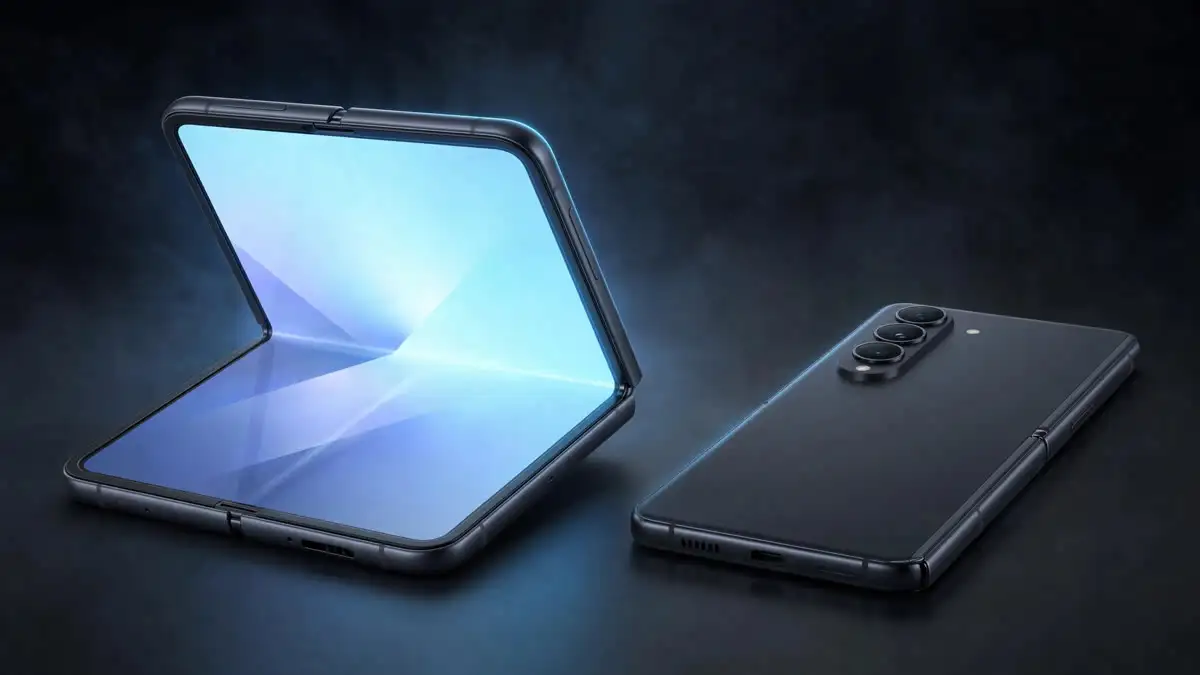
Apple’s first foldable is $700 more expensive than its best conventional phone, and both run the exact same chip. The iPhone Duo starts at $1,999. The iPhone 18 Pro Max starts at $1,299. Same A20 Pro processor, same C2 cellular modem, same N1 wireless chip. So what exactly does the extra $700 buy, and what does it take away?
With the Duo’s pre-orders opening October 16 ahead of its October 23 release, and the Pro Max already on sale since September 18, buyers now have confirmed hardware and pricing to compare. Here is where the premium shows up, and where the Pro Max still wins.
The $700 gap, in one table
| Spec | iPhone Duo | iPhone 18 Pro Max |
|---|---|---|
| Starting price | $1,999 | $1,299 |
| Chip | A20 Pro (2nm) | A20 Pro (2nm) |
| Display | 7.6-inch folding OLED + 5.4-inch outer | 6.9-inch OLED |
| Rear cameras | 48MP main + ultrawide | 48MP main + ultrawide + telephoto |
| Zoom | 2x optical-quality crop | Up to 8x optical telephoto |
| Front camera | 12MP | 18MP Center Stage |
| Variable aperture | No | Yes |
| Authentication | Touch ID button | Face ID |
| Video playback | 44 hours (outer) / 31 hours (inner) | 45 hours |
| Weight | 254g | 249g |
| Thickness | 5.2mm open / 11.3mm closed | 8.75mm |
| Water resistance | IP68 | IP68 |
Ten things the Duo leaves behind
The fold is not free, and the trade-offs concentrate in the camera system. MacRumors catalogued what the Duo gives up compared to the 18 Pro line, and the list is long for a $1,999 device.
The Duo has no dedicated telephoto camera, so its zoom tops out at a 2x optical-quality crop from the main 48MP sensor, while the Pro Max reaches 8x optical. It skips the mechanical variable aperture that is the headline camera feature of the 18 Pro generation, along with ProRAW, ProRes RAW, Apple Log, spatial photos and videos, and the LiDAR scanner. The front camera drops from 18MP Center Stage to 12MP. There is no Action button and no Camera Control button, and MagSafe compatibility is reduced.
Then there is authentication. The Duo uses a Touch ID power button instead of Face ID, a concession to the folding form factor that will feel like a step backward to anyone used to glancing at their phone to unlock it. Apple Pencil support is promised but not yet available, and Duo FaceTime remains a forthcoming feature rather than a shipping one.
Where the money actually goes
Strip away the spec sheet and the $700 pays for three things: the 7.6-inch folding OLED (50 percent larger than the Pro Max’s 6.9-inch screen), the liquid-metal hinge assembly, and the engineering required to make a 254-gram device that folds at all, only 5 grams heavier than the Pro Max despite the second screen.
It is also worth noting what the Duo does not compromise. The IP68 rating, immersion to 6 meters for 30 minutes, matches the Pro Max and comfortably beats Samsung’s Galaxy Z Fold 8 at IP48. Battery life on the outer display essentially matches the Pro Max at 44 versus 45 hours of video playback, though heavy use of the inner display drops that to 31 hours. The aerospace titanium frame and crease-free display, if Apple’s claims hold up in real-world use, are genuine engineering achievements.
Supply is the open question. Component bottlenecks around 2nm chips, hinge assemblies, and memory are already shaping availability, and TrendForce forecasts Apple shipping around 5 million Duo units in 2026, which would capture nearly a quarter of the entire foldable market. Expect the usual launch-week scarcity, especially since the Duo arrives five weeks after the Pro line.
Who should buy which
Buy the iPhone Duo if you want the largest possible screen in a pocketable device, you read, multitask, or watch video on your phone for hours, and you can live with a merely good camera instead of the best one Apple makes. At $1,999 it is a luxury purchase, and it behaves like one.
Buy the iPhone 18 Pro Max if photography or video matters to you at all, if you want Face ID, the Action button, and the full set of pro camera controls, or if you simply want the most complete iPhone Apple sells this year. You will save $700 and get the better camera system, better battery life on the big screen, and a phone you can actually buy today.
The base iPhone 18, for its part, is not expected until spring 2027, so this is the entire fall lineup decision. For deal hunters, the previous generation is already discounted, with the iPhone 17 dropping to an effective Rs 79,999 in Flipkart’s Big Billion Days sale. And whichever phone you pick, it will run iOS 27, with the 27.2 beta already revealing what’s next.