
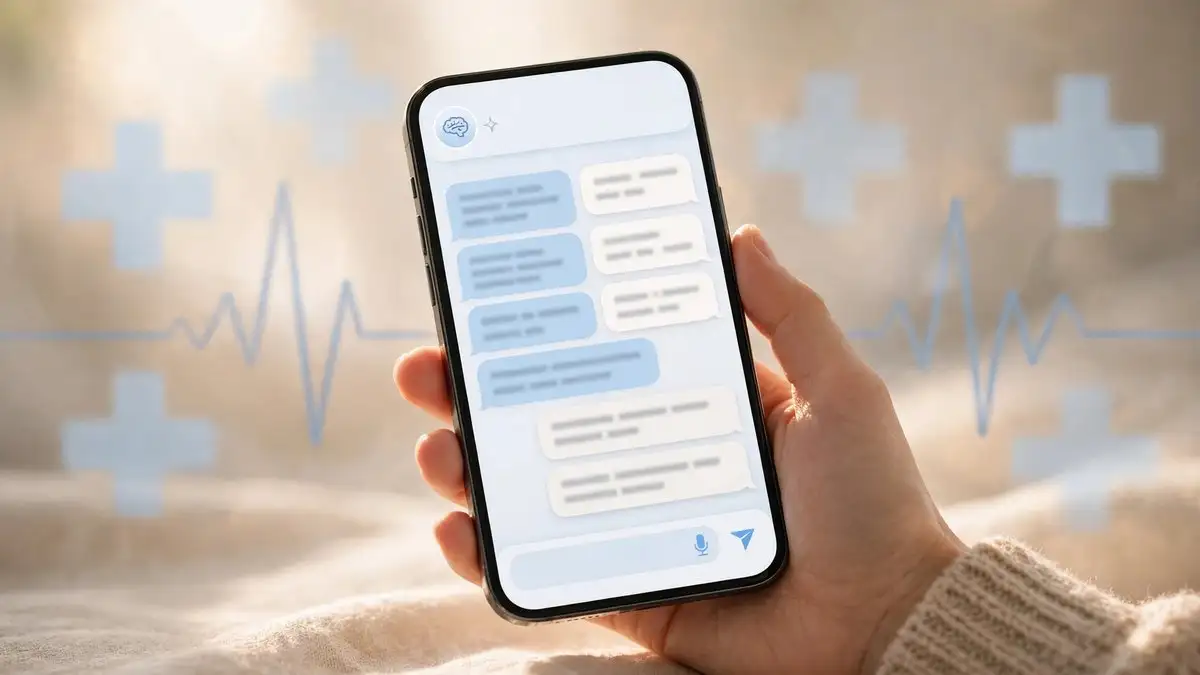
Apple is not launching a health chatbot. It is launching a study to find out whether one should exist. On Sunday, November 15, the company opened enrollment for the Apple Health AI Usage Study, a US-only research project that will let up to 200,000 iPhone owners ask a conversational AI their everyday health questions, and then grade the answers.
The study is run with OpenEvidence, a clinical AI platform used by healthcare professionals. Apple says the goal is to understand what makes people trust AI-generated health information, how well they understand it, and whether it changes what they actually do about their health. The findings, Apple says, will shape how health AI is designed, by Apple and by the industry.
What participants actually do in the study
Participants get a dedicated iPhone app, available now in the US App Store, where they can ask everyday health questions in plain language. Answers come with linked, peer-reviewed citations, drawn from medical literature including The New England Journal of Medicine, the Journal of the American Medical Association, and Nature.
Joining is optional at every step. Participants can choose to share HealthKit data, such as resting heart rate, activity, sleep, or lab results, to see whether personal data makes the answers more relevant. They can also answer surveys about how they understood a response and whether it helped them prepare for a doctor visit. Apple says participants are asked to stay in the study for up to 12 months.
The study measures trust, comprehension, and behavior. It does not measure clinical outcomes, and Apple is blunt about that boundary. The app is not meant to diagnose or treat any condition, and it does not replace a doctor. Safety guardrails are meant to catch concerning questions and point people toward a healthcare provider.
The privacy promises, and what they are worth
Health data is the most sensitive data on a phone, so the privacy terms matter more than the features. Apple says study data will not be used to train AI models, participants control whether they share any HealthKit metrics or survey responses, and data is anonymized before it goes to a secure third-party cloud provider. OpenEvidence deletes question and response data within 24 hours, according to reporting by CNET and MacRumors.
Those are unusually specific commitments, and they read like a direct answer to the obvious objection: a company that sells phones should not need your medical questions to build a product. Apple is framing this as research first, product second, or maybe never. “At Apple, we believe responsible innovation starts with scientific rigor and clinical grounding,” said Sumbul Desai, Apple’s vice president of Health and Fitness, in the announcement. “Health is deeply personal, and conducting a dedicated research study is the most thoughtful way to understand how people engage with, comprehend, and evaluate health AI in everyday life.”
Robert M. Wachter, professor and chair of medicine at UCSF, put the problem the study is trying to solve more plainly: “Patients and clinicians are both turning to AI, but the tools they use are being built and tested in separate worlds. When patients and doctors draw on versions of the same trustworthy tools, patients arrive prepared, conversations improve, and next steps happen seamlessly.”
Who can join, and who cannot
Enrollment is limited to the United States, to people aged 21 and older, and to owners of an Apple Intelligence-enabled iPhone, meaning an iPhone 15 Pro or later running iOS 26 or later. The 200,000 figure is a ceiling, not a count of signups so far, and Apple has not said how fast places are filling.
That leaves most of the world out, including India, where Apple Intelligence is available but the study is not. For readers outside the US, the study still matters, because its results will shape whatever health features Apple eventually ships worldwide.
Why Apple is doing this now
The timing is not a coincidence. Health is already creeping into Apple’s AI features. The iOS 27.3 beta 2 brought back a redesigned Health app, and Siri AI in the same beta can now access Health data with permission and answer questions about it. A study that watches 200,000 people ask a medical AI questions is the research base for that direction, and it gives Apple a defensible answer the next time someone asks whether an AI should be giving health advice at all.
There is also a competitive logic. Millions of people already ask ChatGPT and Claude health questions every day, with no clinical grounding, no citations, and no study watching what happens next. Apple is betting that the company which can show its health AI was tested properly will win the trust that matters most in this category.
What this means for you
If you are in the US, 21 or older, and own a compatible iPhone, you can download the study app and enroll today. Read the consent screens carefully, share the smallest amount of HealthKit data you are comfortable with, and remember that nothing in the app counts as medical advice.
If you are anywhere else, the practical takeaway is simpler: Apple is treating health AI as a research problem before it becomes a product, and the results of this study will decide what health features arrive on your iPhone next. That is a slower path than shipping a chatbot, but for health, slow is the point.
Sources: Apple Newsroom, November 15, 2026; MacRumors, November 16, 2026; TechCrunch, November 15, 2026.