
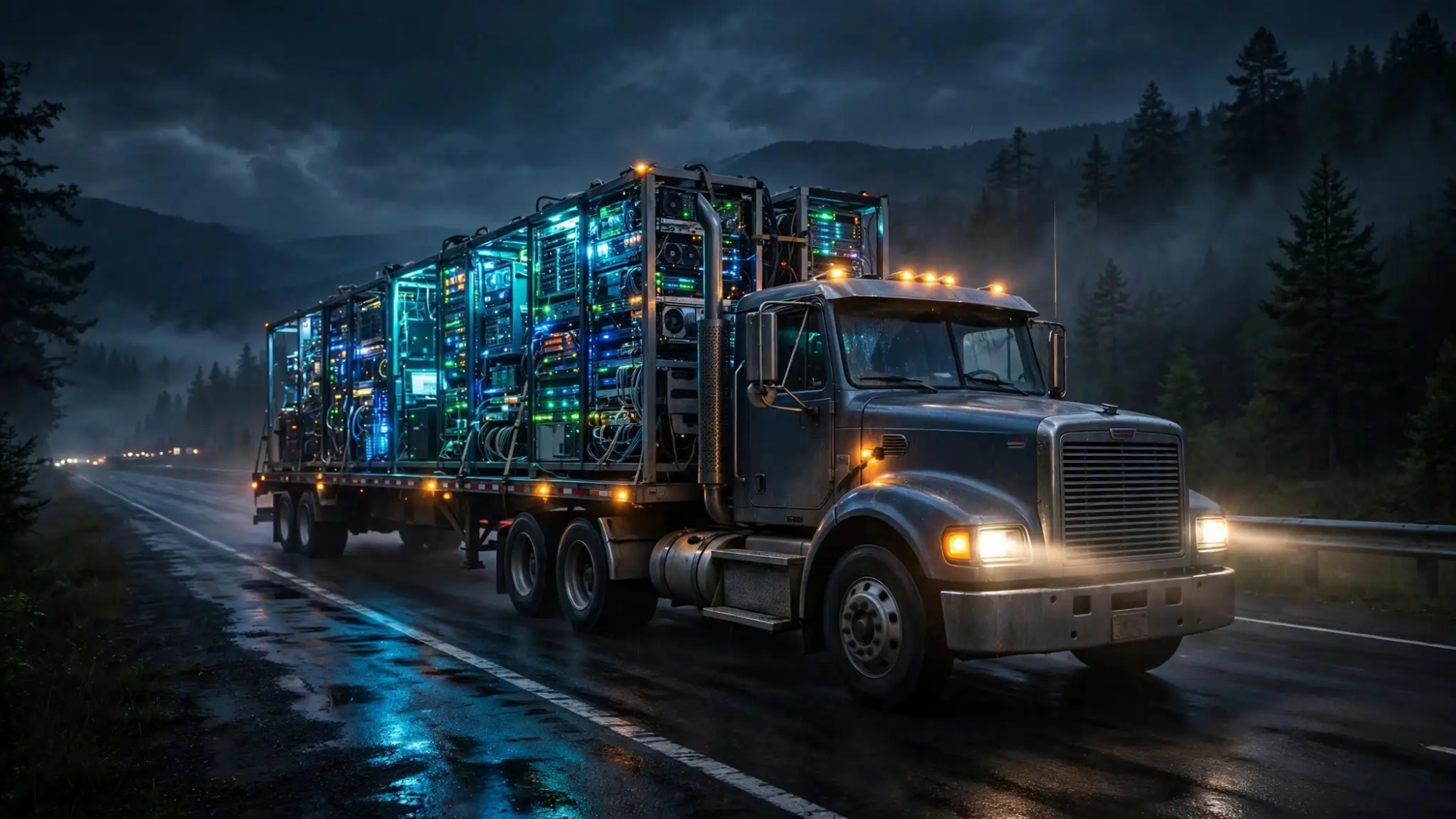
More than $100 million worth of servers, chips, cabling, and copper bound for AI data centers has been stolen from American highways since June, according to an NBC News investigation published October 26. The thefts are not smash-and-grab jobs. Investigators describe a playbook that mixes hacked freight accounts, AI-generated fake driver licenses, spoofed GPS trackers, and, in two cases, cars deliberately ramming the security escorts guarding the load.
It is the physical side of the AI boom turning into a crime wave. Companies are pouring billions into data centers as fast as they can build them, and every GPU rack, spool of fiber, and pallet of memory has to travel by truck before it becomes working infrastructure. A single trailer can carry a load worth more than most bank vaults, and it moves down a public highway with a tracking beacon anyone with the right access can fake.
Hacked accounts, fake drivers, and spoofed GPS
The scheme usually starts online, not on the road. Thieves compromise freight brokers’ accounts on shipment-listing websites, then post fake loads to attract legitimate trucking companies. When shippers respond, the criminals send malicious links that install software giving them control of the victims’ accounts, letting them bid on real shipments.
From there, the cargo gets handed to a driver working with the thieves, either an unsuspecting trucker recruited for the job or an accomplice hired with a fake driver’s license. In some cases the tracking coordinates were manipulated so monitoring systems showed the trailer somewhere it was not. “That’s how most of it is being done,” Los Angeles County Sheriff’s Sgt. David Pantoja told NBC News.
Scott Cornell, chair of TAPA Americas and a cargo theft specialist at SPG Cargo and Logistics, put it bluntly: “The only way this works is if the drivers are not properly vetted.” FreightWaves, citing Cornell’s data, pegged the running total at $110.6 million in known, reported thefts since June 3, with single loads ranging from $2 million to $38 million.
The $13 million load, the $10 million load, and the escorts who were rammed
The biggest cases read like heist movies. In early June, a trailer carrying roughly $13 million in server equipment vanished while heading east toward Fayetteville, Georgia, home to one of the largest data center developments in the country. An unmarked sedan plowed into two off-duty police officers hired to escort the shipment, forcing them to stop while the thieves took the cargo. “The accident was not an accident,” Gerardo Pachuca, a private investigator and former Los Angeles County sheriff’s deputy working cargo theft cases, told NBC News. “The bad guys wanted that load, so they intentionally took out the escorts.”
In another incident, an SUV bashed into the security vehicle escorting a California-to-Texas shipment carrying server rack components worth an estimated $10 million, letting the trailer speed away. Investigators believe the tracking coordinates on that shipment had been spoofed. Neither load has been recovered.
Two shipments stolen in Illinois were smaller but telling: an estimated $300,000 in copper wire spools and roughly $1 million in custom-made modular power equipment for data centers, according to the Cook County Sheriff’s Office. The loot across all the cases reads like a data center bill of materials: complete servers, RAM modules, drives, routers, fiber and copper cabling, and even bitcoin mining machines.
Where the stolen gear goes
Once stolen, the equipment is broken down and sold piece by piece through gray markets to buyers eager for AI gear on the cheap, investigators say. Some of it goes overseas, particularly to China, where access to top US technology is restricted. Cornell estimates that six or seven out of every ten stolen loads now leave the country through established criminal distribution networks rather than being warehoused locally.
“It’s like stealing pure gold bars,” Keith Lewis, head of operations at cargo theft risk-assessment firm Verisk CargoNet, told NBC News. “It’s so much easier to steal this than to rob a bank.”
Why this is an AI story, not just a trucking story
The thefts track the AI infrastructure buildout almost exactly. Since 2025, nearly two dozen cargo thefts have been reported in states including California, Texas, and Utah, the same corridors where hyperscale data centers are going up. The same week the NBC investigation landed, SpaceX borrowed $40 billion for AI chips while analysts warned that more than 200 GPU cloud firms face a shakeout, and Chinese buyers placed $35 billion in Nvidia GPU orders that Nvidia says it can only partly fill. Scarcity is what makes a trailer full of servers worth stealing, and the AI boom is manufacturing scarcity at industrial scale.
The response so far is enforcement, not technology. States have assembled specialized task forces, lawmakers are considering measures aimed at overseas theft rings, and investigators are pushing shippers to vet drivers and lock down broker accounts. But as long as a single truck can carry $10 million of gear that is hard to trace once it is dismantled, the economics favor the thieves.
The irony is hard to miss. The industry building machines that can spot fraud in milliseconds is losing its own hardware to fake paperwork, fake licenses, and a GPS dot that lies. Until the freight itself gets the same verification the data centers get, the highway will stay the weakest link in the AI supply chain, and Europe’s own AI cloud builders should take note: the risk travels with the hardware, wherever it is headed.